
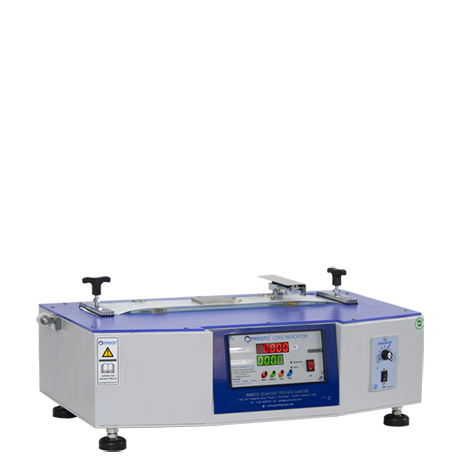
A Coefficient of Friction Tester or COF Tester is used to measure the static and dynamic coefficients of friction of plastic films, foils, and similar materials.
A COF tester measures the coefficient of friction of a test sample by passing a thread under load through the test sample and measuring the force. The COF Tester usually includes an electrical test stand, digital force gauge, weighted COF string, and COF table. The COF tester supports various COF test standards with a wide range of 10 to 305mm/min and a long stroke of 230mm.
A friction tester is a type of testing equipment used to measure the coefficient of friction (COF) of materials. Generally, there are two types of coefficients of friction testing method: static and kinetic
COF (Coefficient of Friction Testing) is a lab testing equipment that is recognized for its role in the manufacturing, transportation, and marketing processes of various products.
Friction testers meet many national and international standards.
• ASTM D1894 – Standard Test Method for Static and Dynamic Friction Coefficients of Plastic Films and Sheets.
• ASTM D202 – Standard Test Method for Sampling and Inspection of Untreated Paper Used in Electrical Insulation.
• ASTM D4918 – Standard Test Method for Static Coefficient of Friction of Uncoated Writing and Printing Papers Using the Inclined Plane Method (Retracted in 2010)
• ISO 8295 – Materials that determine the coefficient of friction are plastics, and foils.
• TAPPI T815 – This is the static coefficient of friction (sliding angle) for packaging and packaging materials such as envelope paper, cardboard, and solid fiberboard.
• TAPPI T816 – Static Friction Coefficient of Corrugated and Solid Boards
Coefficient of friction (COF) testing is used on various materials, from lubricants to foils to household items (ceramic tiles), to determine the frictional properties of materials.
This is generally determined by the slipperiness of two surfaces (often made of different materials) against each other. The value is obtained by dividing the maximum frictional force by the normal power. The dimensionless value of COF is the ratio of the force required to slide the surface to the force normal to the surface. A low COF indicates a smooth surface. Less resistance when sliding. Polymers used to make films are typically dry-tested against a thread with a calibrated load.
Common results for COF are:
static friction or coefficient
Static friction is the force that holds an object at rest to the point where it starts to move. Static COF, therefore, refers to the force that limits the motion of a stationary object on a relatively smooth and hard surface.
It is calculated by taking the initial maximum force required to move the sled and dividing that value by the weight of the sled.
Kinetic friction
Once static friction is overcome, kinetic friction follows and becomes a force limiting normal movement. This dynamic COF is related to the forces that constrain the motion of an object sliding on a relatively smooth and hard surface.
This is calculated by dividing the average load during the test by the weight of the sled holding the other material. Note that peak static force should not be included in average force.
Calculation method of coefficient of friction
If you want to know which combination of surfaces provides better frictional properties, it’s worth knowing how friction is calculated. To avoid friction damage, project engineers usually want a low coefficient of friction.
To do this, divide the drag friction force (Fr) by the normal force pushing the object (N). The general formula for the coefficient of friction (fr) is:
Gold/N=fr
By substituting numbers into this formula, you can calculate the coefficient values.
How does the coefficient of friction value work? Coefficient values are numbers that describe how matter interacts. These values are usually between 0 and 1 but can exceed 1, especially for sticky materials.
If an object has a coefficient value of zero, there is essentially no friction. This is not common but possible with super-fluid materials.
An object that you will be testing can have a friction value greater than 1. For example, rubber is a common material that can have an exceptionally high coefficient of friction. As a general rule, most of the materials will be in the range of 0.3 to 0.6.
Hence, you do understand why industries require the co efficient friction tester and the numerous uses it has.

Nikitha is a passionate writer, guest blogger, and a social media enthusiast. The primary focus is writing high-quality articles after in-depth research and make sure it is a readers delight.